Fucoidan is the name of a family of marine polysaccharides rich in L-fucose and sulfate ester groups. It is not the name of one polymer with a fixed repeating unit and molecular weight. Brown algae are a major source. Reviews trace the first reported isolation to the Swedish researcher Harald Kylin in 1913. Early structural proposals sought a single backbone pattern, but the results accumulated over the following century showed that the choice of alga and the material isolated from it could not be treated as incidental.
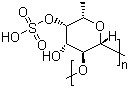
Fucose is a deoxy sugar: compared with a corresponding hexose such as galactose, it has a methyl group in place of a hydroxymethyl group. In fucoidans, ring forms of L-fucose are joined by glycosidic bonds. Published structures include chains primarily linked through the 1 and 3 positions and others in which 1→3 and 1→4 linkages alternate. Such models describe particular preparations or fractions rather than setting a universal pattern. Sulfate ester groups can be attached at different positions along the chains, and some preparations have branches or additional sugar residues. A formula showing just fucose and sulfate cannot encode all of these differences.
The sulfate groups make the polymers negatively charged in ordinary aqueous conditions. Their distribution matters along with the total amount: two chains with equal sulfate content can present charge to their surroundings in different arrangements. Chain length also changes how a preparation behaves. Extraction and purification can select some populations of chains over others, and some processing conditions can alter the chains themselves. It follows that a sample description should specify the species and the preparation and, where available, distinguish the molecular-weight distribution from a single average.
These differences become particularly important in biological experiments. Fucoidan preparations have been investigated in coagulation assays. Sulfation, chain structure and chain length are among the variables considered when comparing results. An effect in an assay can be a starting point for testing molecular interactions, but it is not proof that the whole family has one reproducible activity. Likewise, an experimental result for a fraction of known composition should not be transferred to a commercial extract simply because both labels use the word fucoidan.
One advantage of looking at individual fractions is that the analytical question can be made more specific. If two fractions differ in both sulfate content and chain length, it is difficult to assign a difference in an assay to just one variable. Even a total sulfate measurement says nothing directly about which sugar positions have been substituted. Researchers can compare information from several analytical measurements to decide which part of the difference is explained and which still needs a better experiment. This line of work also offers a historical perspective: as instruments allowed more detailed characterization, the general word fucoidan became an increasingly useful starting point and an increasingly inadequate final description of a sample.
The broad registry number is useful for finding records about this family. The most informative literature goes further and gives a chemical description of the test material. Carbohydrate analysis can establish which sugars are present. Nuclear magnetic resonance can help assign linkages and substitution sites, while separate measurements can describe distributions in chain size. Taken together, these observations turn a general material name into something another laboratory can compare with its own sample. That reproducibility problem has become part of the scientific story of fucoidan itself.
References:
1. Li B et al. Fucoidan: structure and bioactivity. Molecules. 2008;13:1671–1695. https://pubmed.ncbi.nlm.nih.gov/18794778/
2. Jiao G et al. Chemical structures and bioactivities of sulfated polysaccharides from marine algae. Mar Drugs. 2011;9:196–223. https://pmc.ncbi.nlm.nih.gov/articles/PMC3093253/
|





 chemBlink Chemical Story