
Online Database of Chemicals from Around the World
| Shanghai PI Chemicals Ltd. | China | |||
|---|---|---|---|---|
 | www.pipharm.com | |||
 | +86 (21) 58953700 | |||
 | +86 (21) 58953701 | |||
 | sales@pipharm.com | |||
| Chemical distributor since 2007 | ||||
| chemBlink Standard supplier since 2026 | ||||
| Classification | Chemical reagent >> Organic reagent >> Tosylate |
|---|---|
| Name | Benzyl-PEG4-Ots |
| Synonyms | 2-[2-[2-(2-phenylmethoxyethoxy)ethoxy]ethoxy]ethyl 4-methylbenzenesulfonate |
| Molecular Structure | 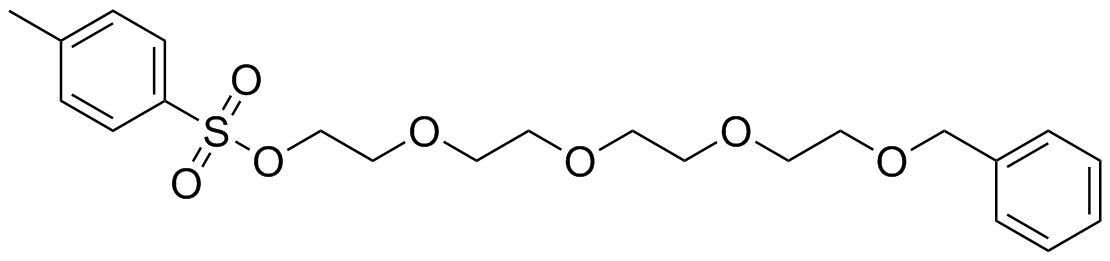 |
| Molecular Formula | C22H30O7S |
| Molecular Weight | 438.54 |
| CAS Registry Number | 89346-82-7 |
| SMILES | CC1=CC=C(C=C1)S(=O)(=O)OCCOCCOCCOCCOCC2=CC=CC=C2 |
| Density | 1.2±0.1 g/cm3 Calc.* |
|---|---|
| Boiling point | 556.6±50.0 °C 760 mmHg (Calc.)* |
| Flash point | 290.4±30.1 °C (Calc.)* |
| Index of refraction | 1.532 (Calc.)* |
| * | Calculated using Advanced Chemistry Development (ACD/Labs) Software. |
| Hazard Symbols |  GHS07 Warning Details |
|---|---|
| Risk Statements | H302-H315-H319-H335 Details |
| Safety Statements | P261-P280-P301+P312-P302+P352-P305+P351+P338 Details |
| SDS | Available |
 chemBlink Chemical Story
|
Benzyl-PEG4-Ots is a short ether chain whose two ends have been given contrasting roles. At one end, a benzyl group caps the oxygen as an ether. At the other, the oxygen belongs to a para-toluenesulfonate ester, conventionally abbreviated OTs. The aromatic rings at the ends are not equivalent: the benzyl ring is attached through a methylene and oxygen, while the tosyl ring is attached to sulfur. Reading the name as merely two aromatic caps on PEG would miss the reactivity that distinguishes them. Tosylation is useful because it changes the chemical behavior of an alcohol-derived terminus without removing its oxygen during the initial transformation. In a subsequent substitution, an appropriate nucleophile can attack the terminal carbon and the oxygen-containing tosylate group can leave. The new connection is made at carbon. This is different from imagining that every reaction takes place at sulfur simply because the starting group is a sulfonate. The reagent thus offers an activated end for chain construction while the benzyl-capped end remains chemically distinguishable. A second common confusion involves the term tosyl and a para-methylbenzyl group. Both include an aromatic ring with a methyl substituent, but a tosyl group also includes sulfur and two sulfur-bound oxygens. The terminal sulfonate is not the same as a methyl-substituted benzyl ether. This distinction can be established directly from the structure; a supplier's broad classification as a PEG linker does not retain that level of information. The molecule is documented as a synthetic linker reagent. Its defined chain length makes it possible to know the number of atoms added in a particular construction rather than relying on an average polymer mass. Catalog placement in a PROTAC section is a description of a possible synthetic context, not evidence that the reagent itself recruits a ligase or degrades a protein. Neither end supplies the pair of biological recognition elements required for a conventional bifunctional degrader. Its supported role is preparative chemistry: one capped end, one activated end and an ether-containing spacer between them. References: 1. PubChem. Benzyl-PEG4-Ots, CID 13270656. https://pubchem.ncbi.nlm.nih.gov/compound/13270656 2. MedChemExpress. Benzyl-PEG4-Ots, CAS 89346-82-7, structural specification. https://www.medchemexpress.com/benzyl-peg4-ots.html |
| Market Analysis Reports |