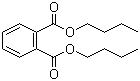
Dibutyl phthalate (DBP), CAS 84-74-2, is the di-n-butyl ester of phthalic acid and one of the historically important members of the phthalate family. For much of the twentieth century, DBP was valued as a versatile plasticizer and formulation ingredient in plastics, adhesives, coatings, lacquers, and other products. Its later history, however, became equally important: extensive toxicological research and regulatory action turned DBP into a prominent example of how society can reassess an established industrial chemical as scientific knowledge about exposure and biological effects advances.
The original attraction of DBP was straightforward. Many polymers are too rigid or brittle for their intended applications. Plasticizers are relatively small molecules that can position themselves among polymer chains, reduce intermolecular interactions, and increase chain mobility. The result is a softer and more flexible material without chemically rebuilding the polymer itself. DBP performed this function effectively and was used in numerous polymeric and formulated products.
DBP also proved useful outside conventional plastics. Its combination of low volatility, organic solubility, and compatibility with other ingredients led to applications in adhesives and sealants, paints and coatings, printing inks, cellulose-based materials, and other formulations. Historical sources also describe uses in products such as nail coatings and as a solvent or carrier for certain organic ingredients. These varied applications illustrate why phthalate esters became such important formulation chemicals during the expansion of twentieth-century consumer and industrial manufacturing.
The same chemistry that makes an external plasticizer useful also creates an important limitation. DBP is not normally covalently bonded to the polymer chains surrounding it. It can therefore migrate gradually from a finished material. Release may occur during manufacturing, product use, weathering, or disposal, allowing DBP to enter indoor dust, air, water, soil, and biological systems. The widespread historical use of phthalates consequently made human and environmental exposure an important field of research.
Toxicological studies changed the scientific and regulatory status of DBP substantially. Experimental animal studies demonstrated reproductive and developmental effects, with effects on male reproductive development becoming an important concern in phthalate risk assessment. Research also examined endocrine-related mechanisms and the metabolites formed after DBP enters the body. These findings made DBP one of the more closely regulated members of the phthalate family.
In the European Union, DBP is identified as a Substance of Very High Concern under REACH on the basis of reproductive toxicity and endocrine-disrupting properties for human health and the environment. It is included in the REACH Authorisation List, and restrictions limit DBP together with several other phthalates in plasticized materials and specified consumer applications. DBP is also prohibited as an ingredient in cosmetic products marketed in the European Union.
Regulatory evaluation continues elsewhere as well. In December 2025, the U.S. Environmental Protection Agency released its final TSCA risk evaluation for DBP. EPA identifies plasticization, adhesives and sealants, and paints and coatings among its primary uses. The evaluation considers occupational, consumer, general-population, and environmental exposures across the chemical's lifecycle, demonstrating how modern chemical assessment extends far beyond the conditions inside a factory.
DBP is also an important environmental contaminant. Because phthalate esters have been used in enormous quantities and are not permanently attached to many of the materials containing them, they have been detected in diverse environmental media. Their environmental fate depends on processes including partitioning, biodegradation, and wastewater treatment. Aerobic biodegradation can contribute substantially to the removal of phthalate esters, while their interactions with particles and organic matter influence where they accumulate.
The history of DBP therefore illustrates two eras of industrial chemistry. In the first, success meant finding a small molecule that could make materials easier to manufacture and better suited to everyday use. In the second, scientists learned that performance inside the product was only part of the story. Migration, exposure, metabolism, environmental release, and long-term biological effects also had to be understood.
Dibutyl phthalate remains useful as a case study precisely because both parts of its history matter. It helped demonstrate the extraordinary power of additives to alter material properties, but it also helped change how additives themselves are evaluated. Modern materials chemistry no longer asks only, "Does this ingredient improve the product?" It must also ask, "Who or what may encounter it during the entire life of that product?"
References
1. U.S. Environmental Protection Agency (2025). Risk Evaluation for Dibutyl Phthalate (1,2-Benzenedicarboxylic acid, 1,2-dibutyl ester) (DBP). U.S. EPA DBP Risk Evaluation
2. European Chemicals Agency. Dibutyl phthalate (DBP), CAS 84-74-2: Candidate List of Substances of Very High Concern for Authorisation. ECHA Dibutyl Phthalate
3. Gao, D.-W.; Wen, Z.-D. (2016). "Phthalate esters in the environment: A critical review of their occurrence, biodegradation, and removal during wastewater treatment processes." Science of the Total Environment, 541, 986-1001. https://doi.org/10.1016/j.scitotenv.2015.09.148
|








 GHS08;GHS09 Danger Details
 chemBlink Chemical Story