
Online Database of Chemicals from Around the World
| Simagchem Corporation | China | |||
|---|---|---|---|---|
 | www.simagchem.com | |||
 | +86 13806087780 | |||
 | +86 (592) 268-0237 | |||
 | sale@simagchem.com | |||
| Chemical manufacturer since 2002 | ||||
| chemBlink Standard supplier since 2008 | ||||
| Hangzhou Ocean Chemical Co., Ltd. | China | |||
|---|---|---|---|---|
| www.hzoceanchem.com | |||
| +86 (571) 8802-5872 | |||
| +86 (571) 8802-5871 | |||
| sales@hzoceanchem.com | |||
| Chemical manufacturer | ||||
| chemBlink Standard supplier since 2011 | ||||
| Ereztech LLC | USA | |||
|---|---|---|---|---|
| www.ereztech.com | |||
| +1 (888) 658-1221 | |||
| sales@ereztech.com | |||
| Chemical distributor since 2010 | ||||
| chemBlink Standard supplier since 2011 | ||||
| Zegen Metals & Chemicals Limited | Hong Kong | |||
|---|---|---|---|---|
| www.zegmetal.com | |||
| +86 18974905158 | |||
| info@zegmetal.com | |||
| Chemical distributor since 2013 | ||||
| chemBlink Standard supplier since 2013 | ||||
| DQ Pure | Indonesia | |||
|---|---|---|---|---|
| dqpure.com | |||
| +86 13588024337 | |||
| lu@dqpure.com | |||
 | WhatsApp:+8613588024337 | |||
| Chemical manufacturer since 2008 | ||||
| chemBlink Standard supplier since 2026 | ||||
| Advance Research Chemicals, Inc. | USA | |||
|---|---|---|---|---|
| www.fluoridearc.com | |||
| +1 (918) 266-6789 | |||
| +1 (918) 266-6796 | |||
| sales@fluoridearc.com | |||
| Chemical manufacturer | ||||
| ProChem, Inc. | USA | |||
|---|---|---|---|---|
| www.prochemonline.com | |||
| +1 (815) 398-1788 | |||
| +1 (815) 398-1810 | |||
| prochem3@aol.com | |||
| Chemical manufacturer since 1986 | ||||
| Xinyu Dongpeng Chemical Co., Ltd. | China | |||
|---|---|---|---|---|
| www.rubidium-cs.com | |||
| +86 (790) 686-4666 646-4661 646-4662 | |||
| +86 (790) 646-4663 | |||
| jxxydpc@163.com | |||
| Chemical manufacturer since 2000 | ||||
| ChemPur GmbH | Germany | |||
|---|---|---|---|---|
| www.chempur.de | |||
| +49 (721) 933-840 | |||
| +49 (721) 47-2001 | |||
| info@chempur.de | |||
| Chemical manufacturer | ||||
| Strem Chemicals, Inc. | USA | |||
|---|---|---|---|---|
| www.strem.com | |||
| +1 (978) 499-1600 | |||
| +1 (978) 465-3104 | |||
| info@strem.com | |||
| Chemical manufacturer | ||||
| Materion | USA | |||
|---|---|---|---|---|
| www.materion.com | |||
| +1 (216) 486-4200 | |||
| +1 (414) 289-9805 | |||
| info@materion.com | |||
| Chemical manufacturer | ||||
| Classification | Inorganic chemical industry >> Inorganic salt >> Metal halides and halides >> Metal fluorides and salts |
|---|---|
| Name | Rubidium fluoride |
| Molecular Structure | 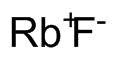 |
| Molecular Formula | RbF |
| Molecular Weight | 104.47 |
| CAS Registry Number | 13446-74-7 |
| EC Number | 236-603-2 |
| SMILES | [F-].[Rb+] |
| Density | 3.557 |
|---|---|
| Melting point | 795 °C |
| Water solubility | soluble |
| Hazard Symbols |    GHS06;GHS07;GHS08 Danger Details GHS06;GHS07;GHS08 Danger Details | ||||||||||||||||||||||||||||||||||||||||||||
|---|---|---|---|---|---|---|---|---|---|---|---|---|---|---|---|---|---|---|---|---|---|---|---|---|---|---|---|---|---|---|---|---|---|---|---|---|---|---|---|---|---|---|---|---|---|
| Risk Statements | H301-H302-H311-H312-H315-H319-H331-H332-H335-H351 Details | ||||||||||||||||||||||||||||||||||||||||||||
| Safety Statements | P203-P261-P262-P264-P264+P265-P270-P271-P280-P301+P316-P301+P317-P302+P352-P304+P340-P305+P351+P338-P316-P317-P318-P319-P321-P330-P332+P317-P337+P317-P361+P364-P362+P364-P403+P233-P405-P501 Details | ||||||||||||||||||||||||||||||||||||||||||||
| Hazard Classification | |||||||||||||||||||||||||||||||||||||||||||||
| |||||||||||||||||||||||||||||||||||||||||||||
| SDS | Available | ||||||||||||||||||||||||||||||||||||||||||||
 chemBlink Chemical Story
|
Rubidium fluoride is an inorganic ionic compound composed of rubidium cations (Rb+) and fluoride anions (F−), with the chemical formula RbF. It belongs to the class of alkali metal halides and exhibits properties typical of highly ionic salts formed between Group 1 metals and halogens. The compound consists of rubidium ions, which arise from the electropositive alkali metal rubidium, and fluoride ions, which are derived from fluorine, the most electronegative element. The strong electrostatic attraction between these oppositely charged ions results in a stable crystalline lattice. In the solid state, rubidium fluoride adopts a cubic crystal structure similar to that of sodium chloride, where each ion is surrounded by ions of opposite charge in a regular coordination pattern. Rubidium fluoride is highly soluble in water, where it dissociates completely into its constituent ions. In aqueous solution, it behaves as a strong electrolyte, reflecting the complete ionic dissociation characteristic of alkali metal halides. The fluoride ion in solution can participate in hydrogen bonding with water molecules and can also act as a weak base, although its basicity is significantly weaker than that of hydroxide. The compound can be prepared by direct combination of elemental rubidium with fluorine gas under controlled conditions, although this reaction is highly exothermic and must be carefully managed due to the extreme reactivity of both elements. More commonly, rubidium fluoride is synthesized by neutralizing rubidium hydroxide or rubidium carbonate with hydrofluoric acid, followed by crystallization of the resulting salt. These aqueous synthesis routes allow better control over purity and crystal formation. Historically, alkali metal fluorides such as rubidium fluoride have been studied as part of fundamental investigations into ionic bonding, crystal structures, and periodic trends. Research into these compounds contributed to the development of modern solid-state chemistry and lattice energy theory. The simple 1:1 stoichiometry and well-defined structure of rubidium fluoride make it a useful model system for understanding ionic solids. Rubidium fluoride has limited large-scale industrial applications due to the relative scarcity and cost of rubidium compared to sodium and potassium. However, it is used in specialized scientific and technological contexts. In materials science and physical chemistry, it serves as a reference compound for studying ionic conductivity, lattice behavior, and optical properties of alkali halides. It is also used in research involving molten salts and high-temperature ionic systems. In some cases, rubidium fluoride is employed in optical and spectroscopic applications, where alkali halide crystals are used as host materials due to their transparency in certain wavelength regions and their well-characterized crystal structures. Additionally, rubidium-containing compounds, including rubidium fluoride, are of interest in atomic physics and quantum research, where precise control of alkali metal ions is required. From a chemical perspective, rubidium fluoride is relatively unreactive under standard conditions, although it can participate in ion-exchange reactions in solution and form complex fluoride species under certain conditions. The fluoride ion’s strong affinity for many metal centers also makes rubidium fluoride a potential source of fluoride in synthetic chemistry. Overall, rubidium fluoride is a simple but important ionic compound that reflects the characteristic behavior of alkali metal halides. Its well-defined crystal structure, high solubility, and strong ionic bonding make it valuable in fundamental chemical research and specialized physical applications, particularly in studies of solid-state and ionic systems. References 2025. New Mixed-Cation Hexafluoridoindate(III) Hydrate of Rubidium and Heterovalent Copper. Journal of Structural Chemistry. DOI: 10.1134/s0022476625110150 2025. Review: factors influencing photoelectric performance of perovskite solar cells. Journal of Materials Science. DOI: 10.1007/s10853-025-11051-w 2024. Hydrogen and Alkali Metals: Elements of the First Main Group. Handbook of the Chemical Elements. DOI: 10.1007/978-3-662-68921-9_1 |
| Market Analysis Reports |